
Why we should encourage (push, goad) our elders into writing their memoirs

It’s true that because I’m a writer, I encouraged (pushed, goaded) my father Bhekh Bahadur Thapa into writing his memoirs, though in my defense, I wasn’t the only one to do so. All of us in the family had taken turns begging him to share his life story in a form that would prove more long-lasting than the interviews he has always been asked for by the insatiable, if ephemeral, news media. My sister Tejshree’s pleas, a few years before she passed away, finally convinced him.
By this time my father was in his eighties. While he was as articulate as ever in speech, he was no longer able to write long-form. My uncle, the wise and worldly former UN official Binod Sijapati, organized for journalist-editor Hari Bahadur Thapa (no relation) to interview my father and to transcribe the interviews in book form. This is a wonderful practice that has taken hold in Nepal over the past decades: a great use of journalists’ skills that led to a flowering of oral histories. My mother Rita Thapa served as the family archivist for the project, providing photos, documents, and other aids to make sure that the memoir was accurate.
About seventy percent of this work was done when my sister Tejshree died. My brother Bhaskar had predeceased her by six years. Grief overtook our family. Then the pandemic hit. Other tasks—such as surviving—took precedence.
A few years later, my uncle Binod and I decided to revive the dormant memoir project. I read the manuscript for the first time, noticed some major omissions, and asked that my father fill in the gaps. With Uncle Binod’s help, and with Hari Bahadur Thapa’s capable ghostwriting—and with my mother’s unflagging support—the manuscript eventually took shape. I requested Basanta Thapa (no relation), editor at the now-gone Himal Books, to give the manuscript a final look-over, and then I coordinated its publication with FinePrint Books. The memoir came out at the end of 2023 and can be found in Nepal’s brick-and-mortar and online bookshops.
It helps to have an author in the family, someone who knows the ins and outs of book writing, editing, publishing—and also translation.
After the memoir came out, I took charge of organizing its English translation, putting it in the hands of ace translator Prawin Adhikari. I knew it wouldn’t be easy to translate a book that ranges over the complicated subjects of finance, governance, history, and diplomacy. Accuracy was going to be as important as style. Prawin Adhikari did a remarkable job. Anagha Neelakantan edited the translation to make it more accessible to a readership who might not know Nepal’s modern history. I did a final edit to clean up the copy. The English translation is officially being launched at the end of this week by Penguin Random House in South Asia.
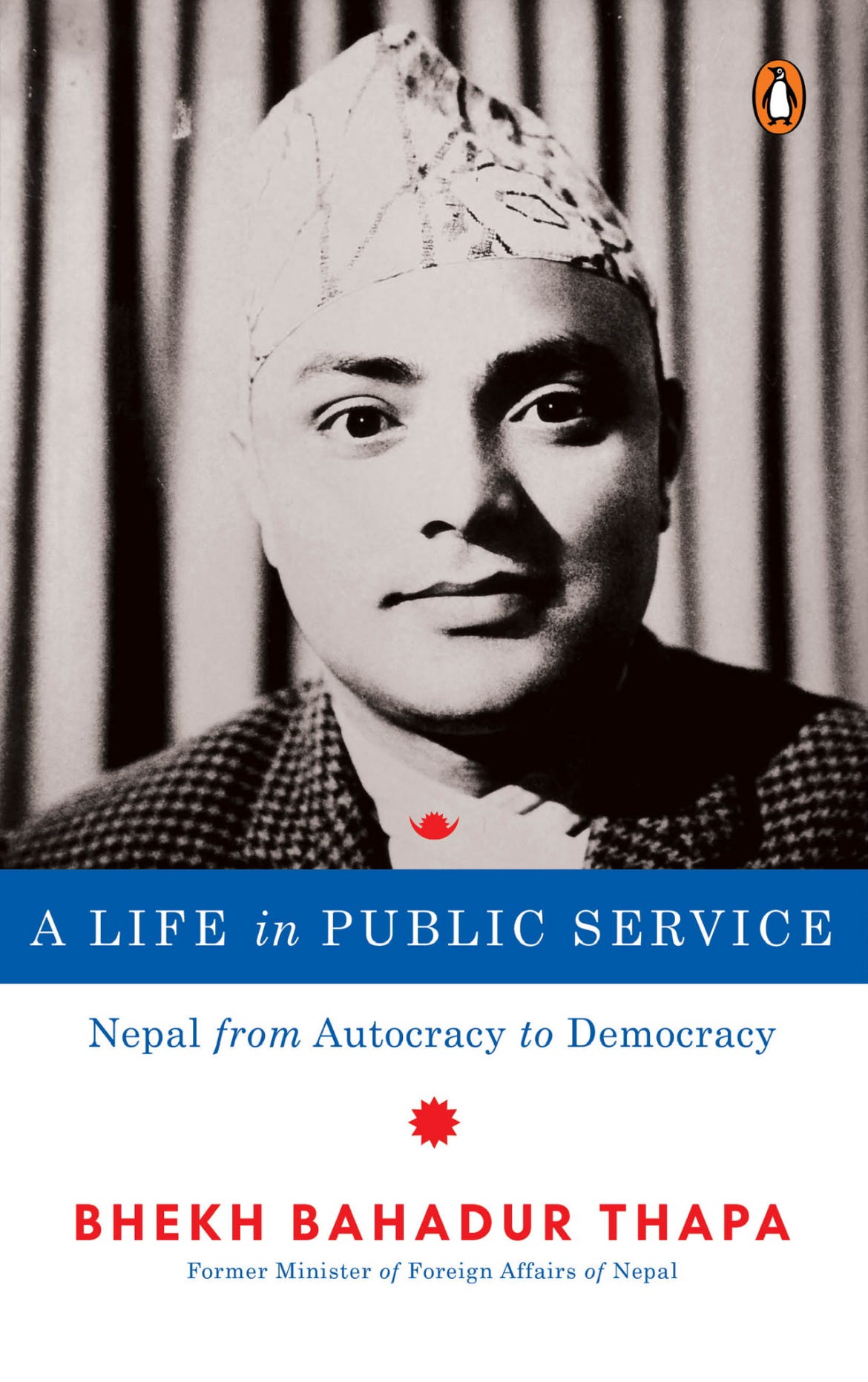
Do pick up a copy if you’re interested in a participant-observer’s view onto how Nepal’s modern state and governance structure came into definition in the decades following the 1950 transition to democracy and King Mahendra’s royal coup in 1960.
While the bulk of the work of producing this memoir was done by everyone else I’ve mentioned, including, principally, by my father, I obviously put a lot of work into it too. Did this delay my own work-in-progress? Yes, it did. Do I regret that? Absolutely not.
I had two clear motivations to guide me.
The private one—to gather personal family memories—is an impulse that many of us feel as our parents, and we, age. As children, and even as young adults, we’re self-centered. We look at our parents through the filter of our own lives and judge them for how they performed in relation to us. And even though we may have heard some of their stories—some far too often—we simply don’t know what they know of the world. We don’t fully understand the the times they have lived through. We don’t truly know them as individuals.
I’ve been gratified to regain this knowledge from my father’s memoirs. Like anyone, I don’t always agree with my father’s views. But now I understand them. And so I’m encouraging my mother Rita Thapa to write her memoirs next. A pioneering public health doctor, she set up Nepal’s family planning and maternal child health project, later rising to the level of director at the World Health Organization. I want to know what she was doing when my siblings and I were following her around on her field trips to supervise vasectomy camps in rural Nepal. (Such were our school holidays). What was it like to work as a woman in a male-dominated profession? What was it like to eventually be the family’s main breadwinner? I already know who my mother is as my mother. I want to know her as an individual.
My second motivation for pursuing these memoirs comes from a desire to build up collective memory. “The past,” as the LP Hartley quote goes, “is a foreign country; they do things differently there.” It’s hard to know how differently they did things in Nepal’s past, because record-keeping has always been weak, and government documents themselves go up in flames too often. This, combined with its young demographics, means that fewer and fewer people share a common sense of the past—and the present. Even the historical abolition of the 240 year-old monarchy in 2008 is a faint memory for the young. Collective memory is very thin here.
I sincerely believe that our elders’ lives, when documented well, can act as the proverbial first draft of history. This is true whether they have led noisy national lives like my parents, or whether they have led quieter lives in the community, family, and domestic spheres. ‘Major’ stories—held to be of national importance—are no more valuable than ‘minor’ ones. Indeed, stories deemed minor often reveal the truths that major stories never get to, or drown out, or worse, cover up.
Our responsibility as adult children is to take care of our elders in their old age. This includes honouring their life stories.
What was it like to be young when our elders were young? What were their dreams, obstacles, achievements? What gave them joy, what caused them sorrow? What traditions were they part of? What innovations—of technology, of lifestyle—did they witness? What rules did they break? Why did they make the decisions they made? What is their own self-assessment? What secrets have they kept all these years?
It is, perhaps, middle age that makes us interested in these questions, that makes us appreciate that everyone is a valuable repository of knowledge. Many of my contemporaries have also set about trying to record their elders’ life stories. In Nepal, it is possible to engage journalists as ghostwriters. AI-generated templates have also come into use worldwide.
I won’t lie. It’s not easy. Getting someone to write their memoirs can require a multi-year commitment for them and for those who are helping them.
My advice would be to start with short-form essays. Try asking your elders to write (or talk) about one specific time in their lives, or a particularly important experience either for the nation or for society or for them or for you. Have them share their expertise in their area of specialization. Or ask them to go by stage of life: birth, childhood, coming of age, young adulthood, and onwards. Create an outline that they can follow.
And don’t feel you have to have everything written down and published in book form. Record your elders on your phone, create short reels, start a podcast, share clips on social media.
Just try something.
At the end you’ll have done your bit to build up collective memory. And you’ll have regained personal family memories.
I promise you won’t regret it.
this reminds me of something my father always used to insist, make videos, shoot anything, write something, create collective memories. "10 years or 20, 30 years down the line, you will thank yourself for that." and yes, looking back at the memories he has collected, i now truly understand the value of his advice.
This title reminds me of Alex Boraine’s 'A Life in Transition,' a reflective memoir of his struggle for transitional justice in South Africa and a go-to reference for those interested in the field, both in concept and practice. I am sure Dr Thapa’s book parallels Boraine’s in the discipline to which he dedicated his life. I will soon grab my copy and read it. Thank you, Manjushreejee, for this piece.